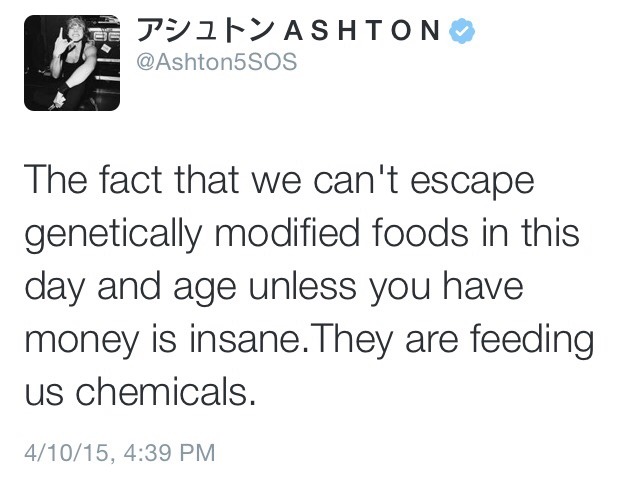
Is this what you guys think it means when GMO comes up in conversation?
Do you know what else is a GMO?
Dogs. Literally ALL dogs have had their genetics modified to make them more docile, loyal, trusting, energetic, obedient ect.
Ears of corn used to be the size of your thumb. Through selective ‘breeding’ we chose the strains of corn that were the biggest, fastest growing, most resilient ect. Ect.
THAT is a GMO. I don’t know where the idea that genetic modification meant they’re injecting your food stuffs with chemicals to change its DNA. That’s not how it works.
However, they ARE spraying your veggies with pesticides and that is something you should be worried about.
Companies like Monsanto are evil. But not because they are breeding crops to feed more people. But because they’re monopolizing the farming market, sueing farmers who share a geographic area and have some of the same strains of crops in their fields because of unavoidable cross pollination and lying about their business practices.
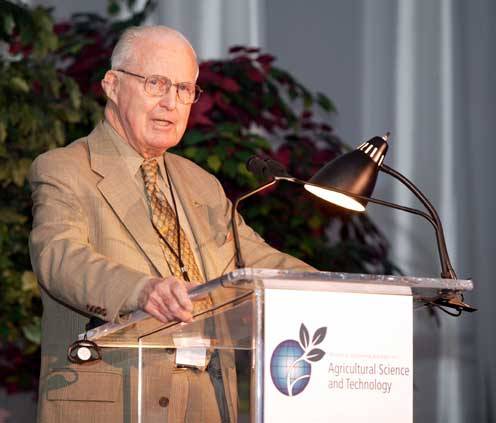
This is Normal Borlaug. In 1942 he received his Ph. D in plant pathology and genetics. In Mexico, he developed semi-dwarf, high-yield, disease resistant varieties of wheat. A genetically modified food. He introduced these to Mexico, Pakistan and India, resulting in double the wheat yields in a 5 year span. In 1970, Borlaug was awarded the Nobel Peace Prize, for saving one billion lives from starvation, and contributing to world peace through increasing the world food supply.
Genetically modified food is great.
This, a thousand fucking times this. Privilege is spouting and spreading pseudo-science bullshit you saw on your Facebook feed or on Twitter because unlike people in drought and famine prone areas of the world, you have the option to do just that. Those other parts of the world that don’t have the benefit of a food surplus and can’t pick and choose what they eat depend on GMOs to not die of starvation or watch their children waste away.
I despise Monsanto as much as the next person and if they ever go out of business, I’ll be the first to dance a jig, but condemning GMOs just because one megacorp is a pile of shitbags is beyond idiotic. If scientists can create new strains of seeds that can withstand disease, pests, all while yielding more foodstuff, then we should be throwing our support behind them.
Also, “They are feeding us chemicals!” is a fundamentally ridiculous statement.
Why?
As a chemist, I’m gonna let you in on a little secret:
Everything is chemicals.
Anti-gmo rhetoric and reasoning is based more on lack of understanding in science and strange doomsday scenarios than proper scientific reasoning and empirical evidence.
Not to be that guy, but genetic modification, seed patenting, and pesticide use almost always go hand in hand which is a far more complicated thing than it’s being made out to be in this post.
If we want to get scientific, of course we can say, “everything is chemicals.” But that’s an egregious oversimplification in this context and ignores the different types of GMOs there are. Some GMOs are developed to be more resistant to pests and no research shows these plants are unsafe to humans. If we leave out the part where the improved productivity of farming never ends up benefitting countries suffering from food scarcity, I concede that this is great!
This is why so many people advocate for the labeling of GMOs, but also why agribusiness companies have worked to shape legislations that would prevent labeling, at least in the US. Agribusiness has also invested heavily in ad-campaigns to frame those that oppose GMOs in any capacity to be anti-science zealots and portray itself as a champion of ending global hunger, all while doing next to nothing (considering how much money it has) to actually feed the hungry.
also the green revolution destroyed indian agriculture due to sterile hybridized plants forcing tenant farmers to depend on seed suppliers which in turn drives them into debt which in turn has led to tens of thousands of suicides
Right, the thing is making large sweeping statements about GMOs usually leads directly into liberal pseudo-science. So we should be careful when we talk about GMOs. They can definitely be used as agribusinesses use them, but there is a huge potential in genetic modification in improving overall human health and food production for greater benefit.
The anti GMO people essentially support genocide, because GMO crops save lives in third world countries.
Like, if your critique of GMOs isn’t only a critique of capitalism and the ability to patent genomes, you’re problematic.
Also that carcinogen study had deeply questionable methodology… that said fuck capitalism and monsanto for being terrible, and well technology is morally neutral
The supposed carcinogens are naturally found in other plants and used in a powered form on “organic” crops
I know. Most critiques of GMOs are really really bad.
Most of these people have probably never taken a single course in environmental science
I’m on your side, but this comment rubbed me the wrong way a lil’ cause like I’m a highschool dropout, and I don’t think you need to resort to academic elitism to challenge the opinions of dickheads.
Sorry, I just had a really irritating experience with bourgeois academics talking about my profession and thinking they were super radical while being profoundly liberal and suggesting like lobbying and community gardens as “revolutionary praxis”
Madeira Darling is a snarky mystic, devout Satanist, serious Marxist, laughing dominatrix, and writer from San Fransisco where they live with their boyfriend in a house full of altars to their various demons.
View all posts by Madeira Darling

 Thoughts From The Peacock Angel