and can’t tell the difference between Edwardian and Georgian and think the Victorian era was in the 18th century.
Like I’m not a snob about it, but if you’re writing about it, a tiny little bit of research won’t kill you, I promise.
Also just because you like the “Victorian Aesthetic” (which you don’t even understand) doesn’t mean you like the Victorian era which was an era of horrific poverty slavery, child labor, colonialism, mass poisoning and general horror and misery.
Just wanted to write a thing on corsets and costume history and how we perceive women’s place in history.
Anyway corsets have a really bad reputation as a symbol of like… the oppression of women, and I think that’s actually pretty weird (as a costume history geek), because like, they’re portrayed as these torture devices and they really aren’t.
Okay let me explain, tight lacing (lacing very tightly so as to modify the shape of your ribcage over time) isn’t super comfy, but it’s also not super uncomfy and no it’s not as bad for your health as the Victorian health alarmists would have you believe. That said most women didn’t tight lace (especially not working class women, who did in fact also wear corsets) most women laced their corsets tightly enough to keep their boobage in place and not much tighter because that was the real function of corsets.
Now if you’re busty (whether through nature, or like me through the surgeon’s art) you know that bras are necessary but in many cases fucking uncomfortable, and that your boobs cause you back pain aplenty. Now here’s the interesting part, corsets (custom-made, properly fitted, real steel or imitation whale boned real corsets) support your titty weight off your strong hips rather than off your weak shoulders, and keep your back straight which for a lot of people with a lot in the boobage department… is kind of a godsend in terms of reducing or eliminating back pain, they also sort of force you to bend at the knees rather than at the waist which is better for your back in the long run.
Incidentally, the crusade against corsetry was initially lead by men who hated the things (the would have shown up on a late Victorian “trends men hate” list TBH) before rational dress folks got ahold of them.
Anyway basically I’m tired of pop culture treating a fairly practical garment that developed to support what needs supporting so it doesn’t flop around and cause trouble and discomfort being treated as a torture device.
Also it somewhat irritates me when people talk about full skirts as if they were super restrictive and cumbersome. People forget that the trousers of the past were often stiff with little give. Hoop skirts certainly were dangerous as fuck in a world full of open flames, but like a full skirt with a few petticoats is warm and allows you honestly, a really large amount of freedom of motion (more than most modern lady pants honestly), I’ve worn long (not floor length, but ankle length) skirts hiking through rough terrain and they’re honestly quite practical, though knee length with high socks works a little better if there’s a lot of stuff to get caught on. Not to mention that although upper class women were highly restricted through most of history through most of the world, a lot of the time your average subsistence farmer would be surprisingly egalitarian (although women typically did the cooking and laundry and “inside” work more and men did the “outside” work more, everybody was doing work that was directly necessary to not dying and so it was pretty different from like the upper-class idea of the woman who was mostly decorative and was utterly reliant on the men around her, basically proles were interdependent, bourgeois and aristocratic folks had dependent women and independent men if that makes sense)
Also is it just me or does it seem like women being socially conditioned to desire desire (more than desiring a given partner), to find being the object of desire more erotic than doing the desiring is a patriarchal thing… like we’re conditioned to desire to be objects of male-gaze without having our own gaze if that makes sense. I know that I personally very much want my partner to be desirable and know they’re desirable and kind of flaunt that desirability and use it in a very “feminine coded” way, idk
I think this is something that developed with capitalism and has correlates interesting with developments in costume history. In 15th century Europe for example women were perceived as the lustful ones and men perceived as “just wanting commitment” while still being an immensely patriarchal group of societies… but men’s clothing was brighter and had a lot more elements of “sexual display” than women’s did at the time (I don’t think clothing is inherently sexual but when unclothed bodies are sexualized and there’s like a contrast in the sexualization of clothing between groups there’s sort of like… something going on semiotically, and this women are lustful rhetoric was used as a justification for the inferior status of women… so like that’s interesting) and in fact the 19th century “women are purer” was a reaction to the historical idea of women as the “lustful” sex (their terminology, not mine, obviously that’s super binarist and essentialist and fucked in a myriad of ways) and this was the period during which European men’s clothes went from pretty and colorful and display-y to drab and boring and sort of intentionally anti-sexual. IDK I think it might have something to do with the fully development of capitalism (which I think really blossomed in the 19th century which fits well with my historical materialist theory of cosmetics usage) but like IDK exactly what it means but it all seems sort of… suggestive of something doesn’t it (no pun intended)
And not way women are written or the contrast with the way male characters are designed or even good old fashioned misogyny.
Because men
(Minoan warriors)
have never
(ancient Egyptian warriors)
worn anything
(Early Hastati)
skimpy
(the Dying Gaul)
or impractical
(French soldier)
into battle
(Zulu warrior 1940s)
Ever
(German landsknechts)
At all
(Maori warriors… who just FYI are the reason New Zealand is founded on a treaty and not a constitution)
Ever
(early Spartan Hoplite)
Nope, no seemingly impractical or skimpy outfits on warriors. What a silly idea.
(Mayan warrior)
a killer-diller coat with a drape shape, reet pleats and shoulders padded like a lunatic’s cell
Malcolm X on Zoot Suits (he was a very stylish man, also zoot suits during the war were a rebellion against social norms and to an extent cloth rationing)
“ As Mary Condren has pointed Out in Serpent and the Goddess (1989), a study of the penetration of Christianity into Celtic Ireland, the Church’s attempt to regulate sexual” behavior had a long history in Europe. From a very early period after Christianity became a state religion in the 4th century, the clergy recognized the power that sexual desire gave women over men, and persistently , tried to exorcise it by identifying holiness with avoidance of women and sex. ExpeliIng women from any moment of the liturgy and from the administration of the sacraments; trying to usurp women’s life-giving, magical powers by adopting a feminine dress; and making sexuality an object of shame “
By adopting a “feminine dress” do you mean normal 4th century Byzantine attire? People wore fuckin’ robes.
Oh look 4th century Byzantine fashion
“Can we say that this large female presence in the heretic sects was responsible for the heretics’ “sexual revolution”? Or should we assume that the call for “free love” was a male ploy designed to gain easy access to women’s sexual favors? “
Here are some sources on why this is bullshit, 1. Because the female presence in most heretical sects was not particularly large and 2. Because “free love” was not a thing these sects preached.
The Oxford Handbook of Women and Gender in Medieval Europe Chapter 31 refutes the idea that women were more likely to participate in heresys (their participation was in fact lower)
“ Significantly -in view of me future criminalization of such practices during the witch-hunt – contraceptives were referred to as “Sterility potions” or maleficia (Noonan 1965: 155-61) “
Her sources on contraception and abortion are from John T. Noonan a very very conservative Catholic judge (appointed initially by Regan) with no training in history whatsoever. His book is revisionism by the modern church with little if any serious basis in history.
Also Oral Contraceptives and Early-Term Abortifacients during Classical Antiquity and the Middle Ages is a good article
“recruits came from all walks of life: the peasantry, the lower ranks of the clergy (who identified with the poor and brought to their struggles the language of the Gospel), the town burghers, and even the lesser nobility. But popular heresy was primarily a lower class phenomenon. The environment in which it flourished was the rural and urban proletariat: peasants, cobblers, and doth workers “to whom it preached equality, fomenting their spirit of revolt with prophetic and apocalyptic predictions”
“ when they succeeded in establishing what (with some exaggeration, perhaps) has been called the first “dictatorship of the proletariat” known in history. Their goal, according to Peter Boissonnade, was “to raise journeymen against masters, wage earners against great entrepreneurs, peasants against lords and clergy. It was said that they had contemplated the extermination of the whole bourgeois class, with the exception of children of six and the same for the nobles” “
Also she references P. Boissonnade/P. Boissonade work “Life and Work In Medieval Europe” frequently, and I can find essentially no material on who Boissonade/Boissonnade (it’s spelled both ways in references to him) other than what he wrote. His name may have been Peter, Pierre or Prosper and I HAVE NO IDEA WHICH AND FUCK THIS REFERENCE oh wait there’s a dead link about him on German Wikipedia. OH WAIT IT MAY NOT EVEN BE A HE EVEN THOUGH SILVIA CALLS HIM PETER. Prosper Marie Boissonade is… a French historian from the turn of the century and it is impossible to find anything very thorough on them.
“ On average, half of the town male youth, at some point, engaged in these assaults … / … For proletarian women, so cavalierly sacrificed by masters and servants alike the price to be paid was inestimable. Their reputation being destroyed, they would have to leave town or nun to prostitution ( ibid.; Ruggiero 1985: 99)”
Here’s the sourced material, Ruggiero’s book doesn’t back up what she’s saying. Also if half the town’s male youth was doing this… like… numerically I think that might not make sense.
Cause I know there were Mexican folks in the international brigades and I know that anarchists fled to various places in Latin America (among other places) after Franco won.
Cause CNT militia women (note the fatigues with flawless 30s hair and makeup:
Pachucas: Note the zoot suits and flawless 40s hair and makeup
Ok so you have fairly egalitarian hunting/gathering type societies, you’ll notice that in these societies makeup is used equally by pretty much all men and women or sometimes to denote specific roles (like religious official or similar) or particular activities (you paint your face a specific way at this particular festivity)
Then you have monarchies, peasants and lower class people no longer wear makeup, makeup is worn by all members of the aristocracy regardless of gender. Merchant class people may or may not wear some makeup. Ancient Egypt was an exception of course as at least eyeliner was used by nearly everyone (though Egypt being uniquely fertile and uniquely predictable allowed more luxuries for common people than elsewhere, and eye kohl both prevented infection and offered protection from sunlight). I am having trouble confirming the cosmetics practices of working people in ancient Japan, but I can say for certain aristocratic men and women did wear makeup, as there are accounts of Samurai rouging their cheeks before battle, as well as of the cosmetic practices of aristocratic women. I know that in ancient China aristocratic women did wear makeup, and we have little evidence on the cosmetics practices of working people and I am having trouble finding sources on what aristocratic men did or did not do. In ancient India cosmetics were used by men and women, but I’m having trouble finding sources on how this related to class.
After bourgeois revolutions you see makeup and adornment being shunned in line with bourgeois values (the victorian era for example, makeup being banned under Cromwell, the French revolution, and actually considering the ultimately state capitalist character of many supposedly leftist revolutions, those too etc) but gradually coming back into favor but only or primarily for women. Proletarian women wear more of it, lumpen prole men also may wear some at various points.
In Ancient Rome and Greece which were closer to bourgeois democracies you seem the same pattern of “generally frowned upon”, and “acceptable if used lightly” by women.
Obviously I’m extrapolating based on data points I have and will need to look for more examples and counterexamples world wide, but it is interesting.
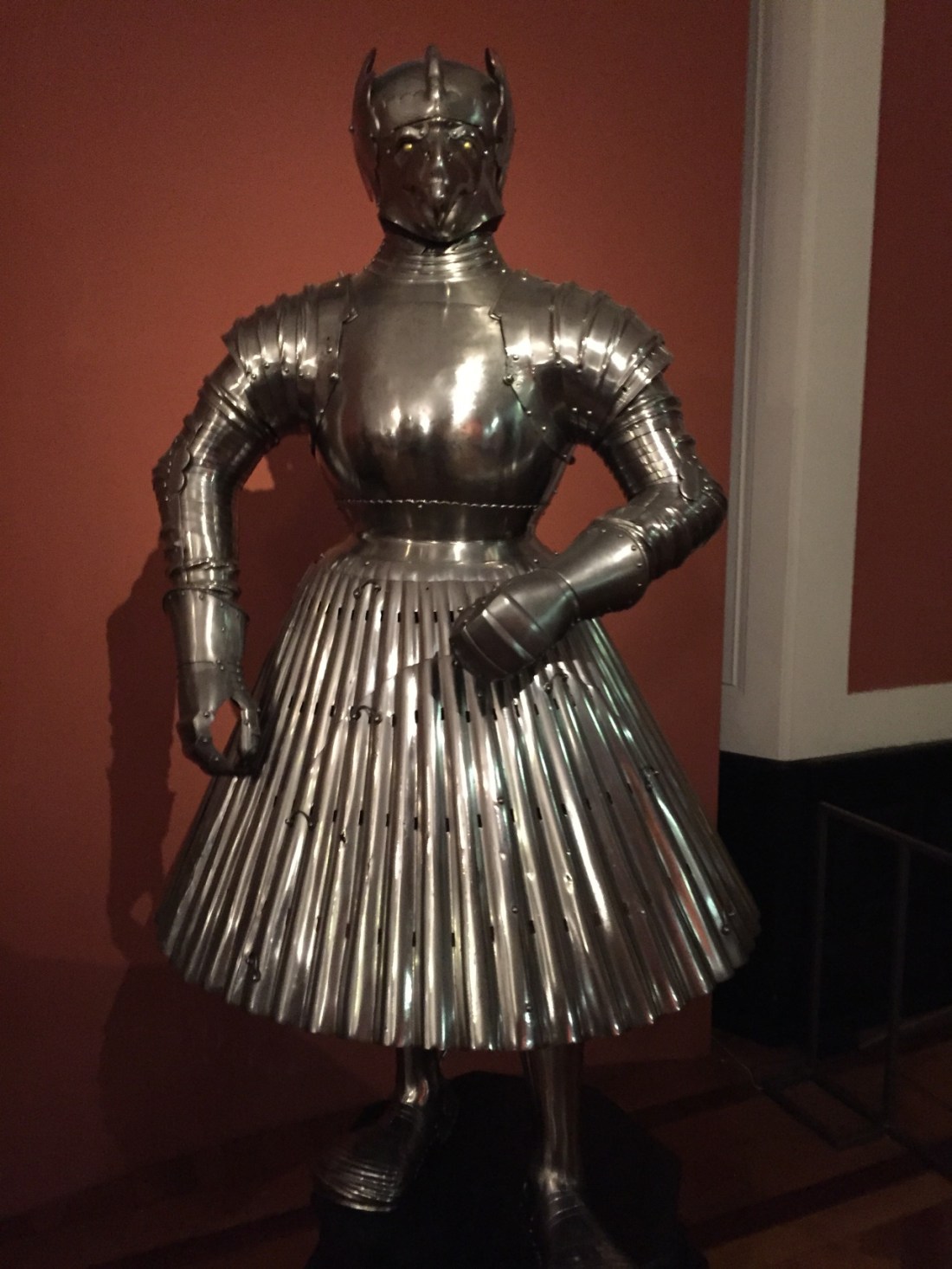
Also you see the fouffy circle skirt thing? That’s called a tonlet, and it existed for a good reason. Basically armored pants have to have have joints so they can move, and joints mean gaps and gaps mean "OW MY KNEE/THIGH JOINT THE NAME OF WHICH I CAN’T REMEMBER, YOU STABBED IT WITH A SWORD AND/OR SPEAR!”
You know what doesn’t need joints so you can move? A bitchin’ metal version of Christian Dior’s new look. So if you were doing hand to hand to hand combat, and at risk of knee injury, well then there you are.
I keep seeing arguments as to why boob plate should be banned from fantasy art because it is unworkable and will kill you and the argument basically says that should you ever fall down or get a blow to the chest, your armor will crunch in on your sternum killing you instantly This argument makes me mad partially because it’s not true, and partially because people’s proposed solutions are usually shitty boring ass “realistic”/”practical” armor (that’s wildly unrealistic and just exists in their imagination because of modern ideas of utilitarianism and practicality and the Victorians removing all the fouffy fabric bits and beautiful paint work from medieval suits of armor so that it looked “right” to them) so here’s my explanation of why it’s wrong and what we should do instead of the boring shit people usually suggest.
1. The problem isn’t whether or not it’s accurate, the problem is whether or not it’s misogynist, Most fantasy armor wouldn’t articulate right, has pointy sticky offy bits that would fuck you up in all sorts of ways, and removes a lot of the ornate metal work and fabric decoration that armor actually involved, but it’s fantasy SO THAT’S OKAY
The issue is that we keep hypersexualizing every goddamned female character ever put in armor and not doing the same thing to dudes, either put the dudes in a chainmail loincloth or don’t draw goddamn boob plate. I mean don’t even get me started on how leather armor is used so goddamned often when it was in fact a weird and incredibly rare choice.
Making it about accuracy distracts from the fact that the actual issue at hand is misogyny.
2. Ever seen Lorica Musculata?
3. That would only happen if you hammered a cleavage line in to a regular cuirass, if you hammer cups out, poured molten metal into a mold, or added boobs externally onto a cuirass (because I mean the real ones are kinda behind a bunch of padding) you’d be fine. This also assumes that armor bends or breaks MUCH more easily than it actually does. Armor is THICK bronze or steel.
4. But the real thing is, the onus is not on you to prove it’s impossible, the onus is on designers to justify why they’re putting it in there in the first place. Especially if you’re doing something where the designs are based on any actual period of history rather than a mishmash, because like men’s armor was based on the fashion trends of the day, and honestly designers are always missing out on awesome design inspiration, because like they could be using ladies’ fashion of the era to inspire their designs and it’d look fucking cool. I mean there are some eras where boob plate makes sense (17th century, ancient rome) and others where it doesn’t (13th to 16th century)
But seriously let’s have a loot at some fashion and armor of history:
14th century:
15th century:
16th Century:
Please note how the men’s fashion mirrors the silhouettes of the armor and vice versa, now please use more creativity in your costume design, armor was way more interesting and varied than most fantasy artists draw and it sucks, also make use of the elaborate headdresses, they look awesome. Like you don’t need to feel utterly bound to historical accuracy but the dull consistency of silhouettes in a lot of fantasy armor bores me to fucking tears, do some actual research and use some actual historical inspiration
Here’s a shitty scan of my husband being clever and awesome.




 Thoughts From The Peacock Angel